The choice of eye care professionals, occupational testers, and clinical researchers around the globe, for accurate, convenient and rapidly-administered contrast sensitivity measurements.
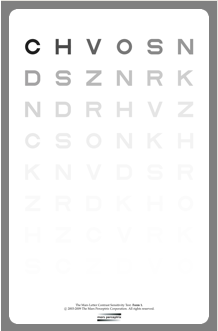
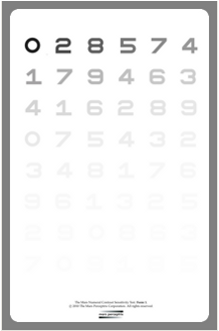
Unlike other contrast tests that assess visual acuity using low contrast targets, the Mars tests are true contrast sensitivity tests that assess the lowest contrasts your patients can perceive, rather than the smallest letters they can identify at some low, arbitrarily chosen contrast. With the Mars tests, it is the contrast, and not the letter (or numeral) size, which diminishes from the beginning to the end of the chart.
Typical Uses
- Monitoring functional effects of disease progression
- Assessing contrast sensitivity prior to and after an intervention
- Occupational testing and licensing
- Identifying functional losses in low contrast perception associated with optical and neural deficits
- Clinical trials for cataract, refractive surgery and ophthalmic pharmacologic agents
- Assessing and monitoring functional disability in low vision
Features and Benefits
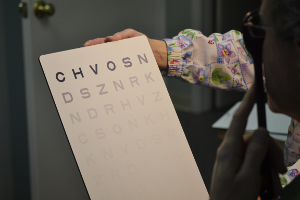
- Hand-held, and designed for convenient near-vision testing.
- Each chart is printed with 48 different contrast levels, declining gradually in 0.04 log unit steps — the finest steps available in any printed contrast test.
- Testing is rapid — generally under a minute per eye for testing and scoring.
- Available in both letter and numeral versions
- Comes with three charts, for the left eye, right eye and binocular testing, or for repeated testing.
- Easy to store and protect.
- Easy to illuminate (e.g., with instrument stand lamp).
- Matte surface allows even lighting with no glare-inducing hot spots.
- Each chart mounted on durable plastic.
- CE-marked as a medical device for sale throughout the European Economic Area